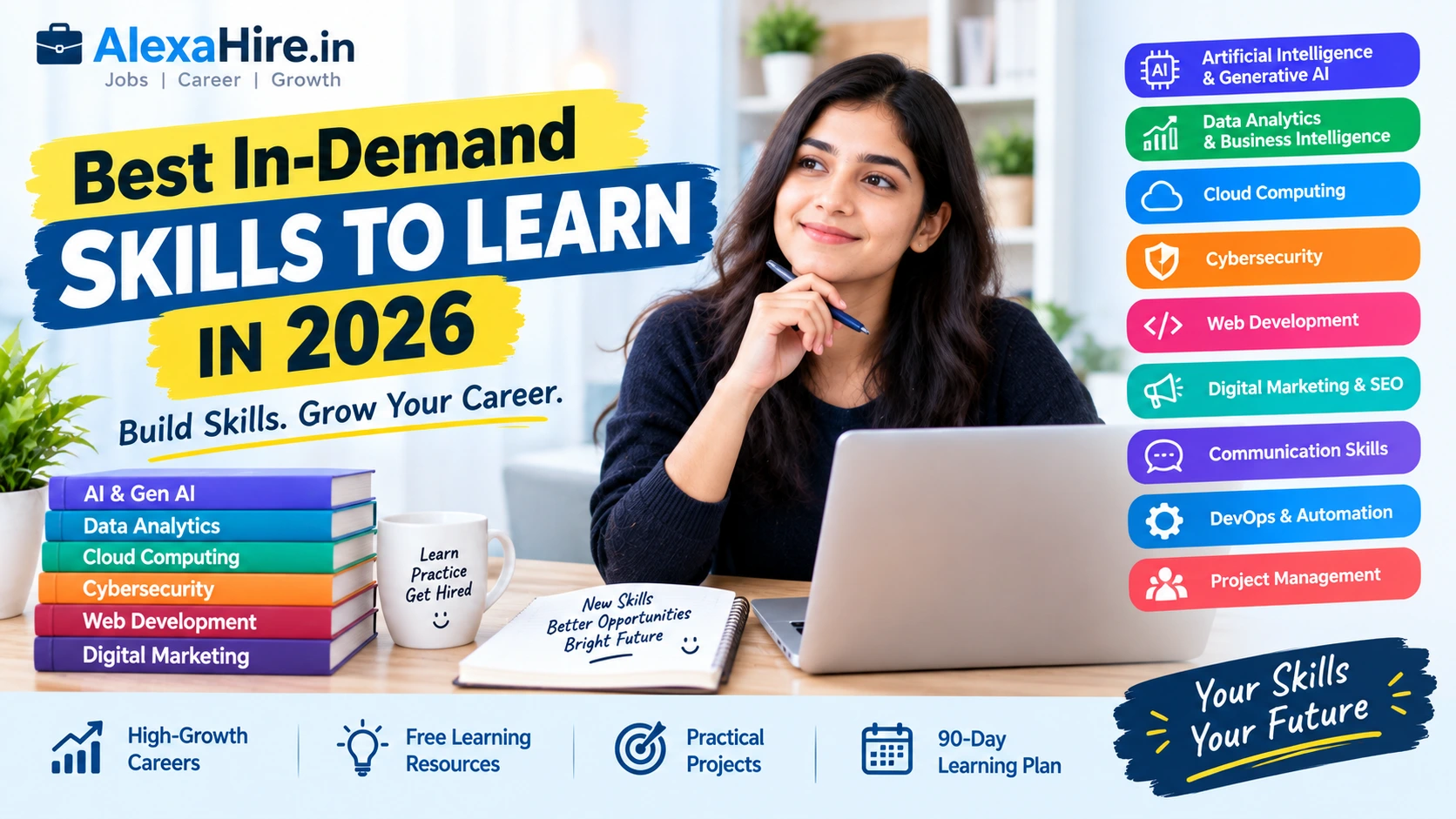
Best In-Demand Skills to Learn 2026 for High-Growth Careers
The job market is changing quickly in 2026. Companies are adopting artificial intelligence, automation, cloud computing, and digital business tools to improve productivity. As a result, candidates who develop relevant technical and professional skills can improve their chances of finding suitable jobs and growing their careers.
Whether you are a college student, a fresher, a working professional, or someone planning a career change, learning the right skills can help you prepare for future opportunities.
According to the India Skills Report 2026, AI, data analytics, cloud computing, and cybersecurity are among the important skill areas for India’s changing workforce. Digital knowledge and practical abilities are becoming valuable across multiple industries.
In this guide, we will explore the best in-demand skills to learn in 2026, the careers connected to them, and how you can start learning even with a limited budget.
Top 10 Best In-Demand Skills to Learn in 2026
Here are ten skill areas worth considering based on your interests, education, and career goals.
1. Artificial Intelligence and Generative AI
Artificial intelligence (AI) is being used in customer support, software development, marketing, data analysis, and business operations. Generative AI tools can help people create content, analyse information, generate ideas, and automate repetitive tasks.
What should you learn?
- AI fundamentals and responsible AI usage
- Prompt writing and evaluation
- Generative AI tools
- Python programming for technical roles
- Large language models (LLMs) and retrieval-augmented generation (RAG) for advanced roles
Career opportunities: AI Engineer, AI Application Developer, Machine Learning Engineer, AI Automation Specialist, and AI-enabled business roles.
Beginners can start by learning how AI tools work and using them for practical tasks. Those interested in technical careers should gradually learn Python, mathematics, APIs, and model evaluation.
2. Data Analytics and Business Intelligence
Businesses use data to understand customers, measure performance, reduce costs, and make better decisions. Data analytics is useful in IT, banking, healthcare, retail, marketing, and many other sectors.
Skills to learn:
- Microsoft Excel
- SQL
- Power BI or Tableau
- Basic statistics
- Data cleaning and visualisation
Career opportunities: Data Analyst, Business Analyst, Reporting Analyst, MIS Executive, and Business Intelligence Analyst.
A good beginner project is to create a sales dashboard using Excel or Power BI. Include charts, monthly comparisons, and a short explanation of the business insights.
3. Cybersecurity
Cybersecurity professionals help organisations protect their systems, networks, applications, and information from digital threats. As businesses depend more on connected systems and cloud platforms, security knowledge is increasingly important.
What should you learn?
- Networking fundamentals
- Linux basics
- Security principles
- Identity and access management
- Threat monitoring and incident response
- Security information and event management (SIEM) tools
Career opportunities: Security Analyst, SOC Analyst, Information Security Analyst, and Security Engineer.
Beginners should first understand computer networks and operating systems. Practise only in authorised labs and environments designed for cybersecurity training.
4. Cloud Computing
Cloud computing allows organisations to use computing resources, storage, databases, and software over the internet. Businesses use cloud platforms to run applications, manage data, and scale their services.
Popular platforms include Amazon Web Services (AWS), Microsoft Azure, and Google Cloud.
Skills to learn:
- Cloud fundamentals
- Virtual machines and storage
- Networking and access permissions
- Cloud databases
- Monitoring and basic security
Career opportunities: Cloud Support Associate, Cloud Engineer, Cloud Administrator, and Cloud Solutions Architect.
Start with one platform instead of trying to learn all three at once. Practise deploying a simple website or creating a small cloud-based project, while monitoring usage to avoid unexpected charges.
5. Full-Stack Web Development
Web development remains a useful career path for people interested in building websites and applications. Full-stack developers work with both the user-facing side of a website and its server-side functionality.
Skills to learn:
- HTML and CSS
- JavaScript
- React or another frontend framework
- Node.js or another backend technology
- SQL or a suitable database
- Git and GitHub
Career opportunities: Frontend Developer, Backend Developer, Full-Stack Developer, and Web Application Developer.
Build projects such as a personal portfolio, a job listing website, or a task management application. A working project is more convincing than a list of completed courses alone.
6. Digital Marketing and SEO
Companies need digital marketing to reach customers through search engines, social media, email, and online advertising. Search engine optimisation (SEO) helps websites improve their visibility in relevant search results.
Skills to learn:
- Keyword research
- On-page and technical SEO
- Content writing
- Social media marketing
- Email marketing
- Website analytics
- Basic advertising campaign management
Career opportunities: SEO Executive, Digital Marketing Executive, Content Strategist, Social Media Manager, and Performance Marketing Specialist.
Beginners can practise by creating a small website, publishing useful articles, and learning how to measure impressions, clicks, engagement, and conversions.
7. Communication and Business English
Technical knowledge is important, but candidates also need to explain ideas, understand instructions, write professional emails, and participate in interviews.
Communication skills are useful in customer support, sales, operations, management, and technical positions.
Focus on these areas:
- Spoken English
- Professional email writing
- Interview preparation
- Presentation skills
- Active listening
- Teamwork and problem-solving
Practise speaking for five to ten minutes every day. Explain a project in simple English, record yourself, and work on clarity rather than trying to use difficult vocabulary.
8. Software Testing and Automation
Software testing helps teams identify defects and ensure that applications work correctly. Automation testing uses tools and scripts to repeat tests efficiently.
Skills to learn:
- Software testing fundamentals
- Test cases and bug reporting
- API testing
- SQL basics
- Selenium or Playwright
- Basic programming for automation
Career opportunities: QA Tester, Software Test Engineer, Automation Test Engineer, and QA Analyst.
Start with manual testing concepts and practise documenting bugs. Once you understand testing workflows, move towards automation tools and scripting.
9. DevOps and Automation
DevOps brings software development and IT operations closer together. It helps teams build, test, release, and maintain applications more efficiently.
Skills to learn:
- Linux and command-line basics
- Git and GitHub
- Docker
- CI/CD pipelines
- Cloud fundamentals
- Kubernetes and infrastructure automation at an advanced stage
Career opportunities: DevOps Engineer, Build and Release Engineer, Platform Engineer, and Site Reliability Engineer.
This field is better suited to learners who enjoy technical problem-solving. Build a foundation in Linux, networking, and programming before moving to advanced tools.
10. Project Management and Analytical Thinking
Project management is valuable for coordinating people, timelines, budgets, and deliverables. Analytical thinking helps professionals understand problems and choose appropriate solutions.
Skills to learn:
- Task planning and prioritisation
- Agile and Scrum fundamentals
- Risk management
- Documentation
- Spreadsheet reporting
- Stakeholder communication
Career opportunities: Project Coordinator, Junior Project Manager, Operations Analyst, and Business Operations Specialist.
You can practise these skills by planning a small project, setting milestones, tracking progress, and documenting what worked and what needs improvement.
Which Skill Should You Learn First?
The best skill depends on your current knowledge and the type of job you want.
| Your Interest | Skills to Start With |
|---|---|
| AI and emerging technology | Python, AI fundamentals, data handling |
| Data and reporting | Excel, SQL, Power BI |
| Cybersecurity | Networking, Linux, security fundamentals |
| Cloud and infrastructure | Linux, networking, AWS or Azure |
| Website development | HTML, CSS, JavaScript |
| Marketing and content | SEO, writing, analytics |
| Testing | Testing fundamentals, SQL, API testing |
| Customer support and operations | English communication, problem-solving, Excel |
| Project coordination | Excel, documentation, Agile fundamentals |
Do not try to learn every skill at the same time. Select one main career path and develop the supporting skills required for that role.
How to Learn In-Demand Skills for Free
You do not always need an expensive course to begin learning. Several online platforms offer free documentation, lessons, exercises, and practice opportunities.
- Microsoft Learn: Explore Microsoft technologies, cloud concepts, and data tools.
- AWS Skill Builder: Study cloud computing fundamentals and practise with available learning resources.
- Google Cloud Skills Boost: Explore cloud and data-related learning paths; check which activities are free.
- freeCodeCamp: Practise web development and programming.
- Cisco Networking Academy: Explore networking and cybersecurity learning resources.
- HubSpot Academy: Learn digital marketing, content, and sales fundamentals.
Some certifications, exams, and advanced learning activities may require payment.
A Simple 90-Day Learning Plan
You can follow this practical plan to build job-ready skills.
Days 1–30: Learn the fundamentals
Choose one career path and study its core concepts for 45–60 minutes a day. Take notes and complete small exercises.
Days 31–60: Practise with projects
Build one or two projects related to your target role. For example, create a dashboard for data analytics or a portfolio website for web development.
Days 61–90: Prepare for jobs
Improve your resume, upload suitable projects to GitHub or a portfolio, practise interview questions, and apply for relevant internships or entry-level positions.
Review job descriptions regularly to identify skills employers actually request. Adjust your learning plan based on those requirements.
Final Thoughts
The best in-demand skills to learn in 2026 are not limited to a single technology. AI, data analytics, cybersecurity, cloud computing, web development, digital marketing, and communication can all support different career paths.
The most effective approach is to choose one skill that matches your interests, practise consistently, and build evidence of what you can do. A combination of relevant technical knowledge, communication, and real projects can make your profile more competitive.
Visit AlexaHire.in for career guidance, interview preparation, and job updates to help you take the next step in your professional journey.
Frequently Asked Questions
1. Which skill is best to learn in 2026?
AI, data analytics, cybersecurity, cloud computing, and software development are worth exploring. The right choice depends on your interests, existing knowledge, and target job.
2. Which skill can a beginner learn without coding?
Digital marketing, SEO, Excel, business communication, and basic data visualisation are possible starting points without advanced coding. Technical roles may require programming later.
3. Can I learn job-related skills for free?
Yes. Many platforms provide free courses, documentation, and exercises. However, some certifications, exams, and advanced courses have fees.
4. How long does it take to learn a new skill?
Basic knowledge may take a few weeks, while developing practical proficiency can take several months or longer. The time required depends on the skill, your starting point, and how regularly you practise.
5. Are certificates enough to get a job?
Certificates can demonstrate learning, but they do not guarantee employment. Practical projects, relevant skills, communication, and interview performance are also important.
6. How many skills should I learn at once?
Focus on one primary skill and a few supporting skills. For example, a data analyst can start with Excel, SQL, and Power BI rather than studying several unrelated technologies together.
Disclaimer: Skill demand varies by industry, location, and employer. This article provides general career guidance and does not guarantee a job, salary, or promotion.
