“`html
Artificial Intelligence is changing the way businesses work, from software development and data analysis to digital marketing and customer support. Learning the right AI skills can help students, freshers and working professionals prepare for changing job requirements.
But which AI skills should you learn first? The answer depends on your career goals. Some roles require programming and technical knowledge, while others benefit from AI-assisted research, content creation and workflow automation.
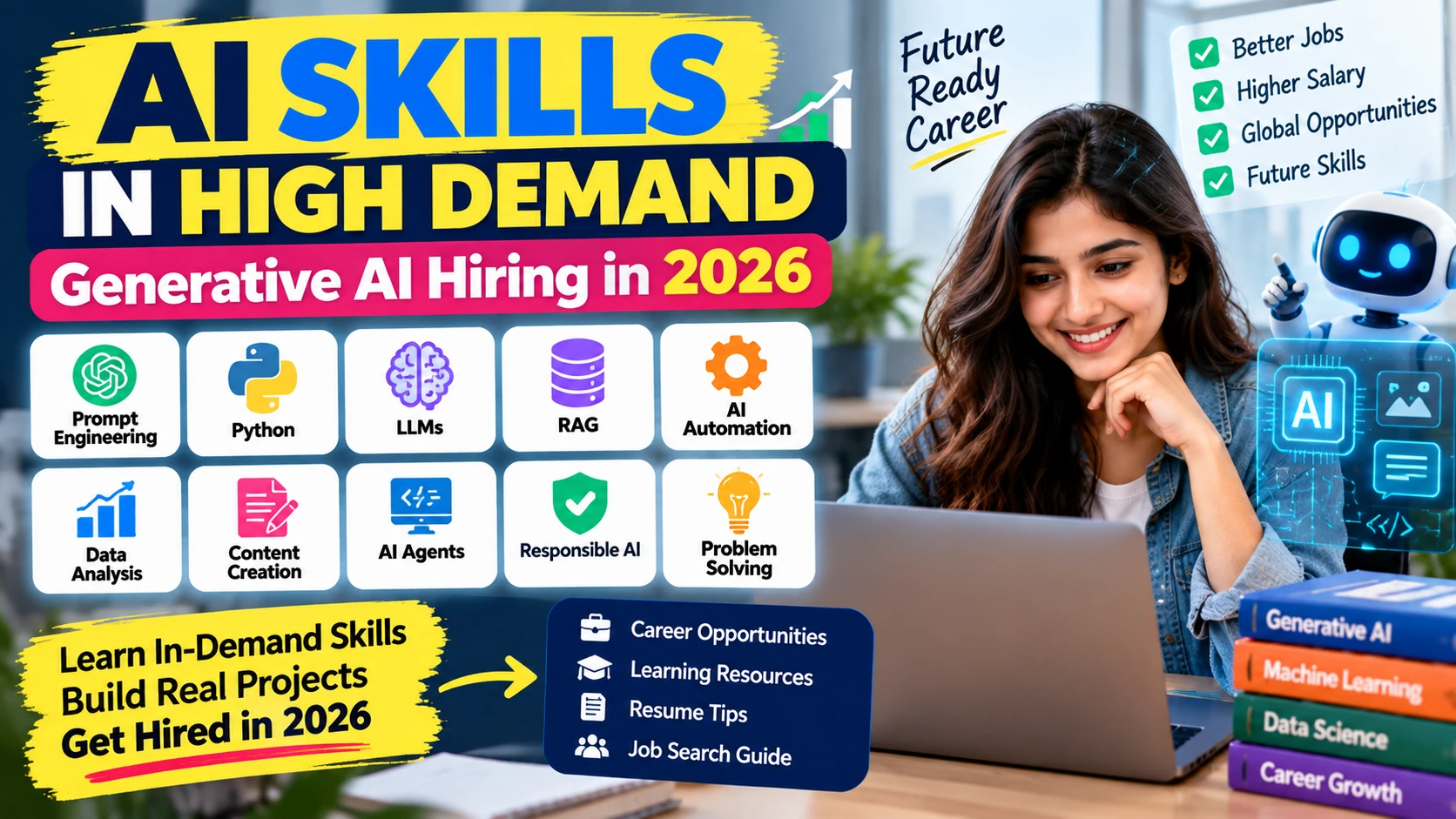
In this guide, we cover 10 AI skills in high demand to explore in 2026, explain how they are used, and share practical projects and learning resources to help you get started.
Quick Overview: AI Skills to Learn in 2026
- For beginners: AI literacy and prompt engineering
- For technical careers: Python, APIs, LLMs and RAG
- For business roles: AI automation and data analysis
- For digital marketing: AI-assisted research, content creation and analytics
- For every career: Critical thinking, communication and responsible AI use
Why Should You Learn AI Skills in 2026?
Generative AI tools can help people draft content, summarise information, analyse data and develop software. Businesses are exploring these technologies for different tasks, but their needs vary by industry, role and level of experience.
Learning AI is not just about knowing how to use a chatbot. It also involves checking the accuracy of its answers, protecting confidential information and understanding when human judgement is necessary.
You do not have to become an AI researcher to get started. A digital marketer can learn AI-assisted research, a data analyst can use AI to support reporting, and a software developer can learn to integrate language models into applications.
10 AI Skills in High Demand to Learn in 2026
1. AI Literacy and Generative AI Fundamentals
AI literacy means understanding what artificial intelligence can do, where it can fail and how to use it responsibly. It is a useful starting point before moving to advanced AI technologies.
What should you learn?
- Basic concepts of Artificial Intelligence and machine learning
- How Generative AI creates text, images and code
- Common limitations, incorrect answers and AI bias
- Data privacy and responsible AI use
Practical project: Use an AI assistant to summarise a public report. Compare the summary with the original document and correct any mistakes.
Suitable for: Students, freshers, HR professionals, marketers and business teams.
2. Prompt Engineering
Prompt engineering involves writing clear instructions and providing relevant context to get more useful results from an AI system. A good prompt explains the task, audience, constraints and expected output.
What should you learn?
- Writing clear and specific prompts
- Providing examples and background information
- Breaking complex tasks into smaller steps
- Testing prompts and improving results
- Checking AI-generated answers before using them
Practical project: Create a set of prompts for resume feedback, interview preparation or customer-support email drafts. Test them on different examples and record their limitations.
Suitable for: Content writers, recruiters, digital marketers, business analysts and developers.
3. Python Programming and Basic Software Development
Python is widely used in data analysis, machine learning and AI application development. Beginners can explore AI tools without coding, but programming knowledge is useful for building more advanced applications.
What should you learn?
- Python basics, functions and data structures
- Working with files, JSON and APIs
- Error handling and debugging
- Basic Git and version control
- Reading documentation and testing code
Practical project: Build a simple Python application that reads a text file and produces a structured summary using an AI API.
Suitable for: Aspiring AI developers, software engineers and automation specialists.
4. Large Language Models (LLMs)
Large Language Models, or LLMs, are AI models used for tasks such as text generation, summarisation and question answering. Understanding their capabilities and limitations helps you use them more effectively.
What should you learn?
- Tokens and context windows
- Choosing a model based on the task, cost and speed
- Structured outputs and function calling
- Output validation and model evaluation
- Basic concepts of fine-tuning and inference
Practical project: Develop a simple FAQ assistant that answers questions using a defined collection of public information. Test how it responds when the answer is unavailable.
Suitable for: Software developers, AI application engineers and technical product teams.
5. Retrieval-Augmented Generation (RAG)
Retrieval-Augmented Generation, known as RAG, allows an AI application to retrieve relevant information from external documents and use it when generating an answer. It is useful for applications that need to answer questions using a specific collection of information.
What should you learn?
- Document loading and text chunking
- Embeddings and semantic search
- Vector databases and retrieval methods
- Connecting answers to source documents
- Testing retrieval quality and answer accuracy
Practical project: Build a question-answering assistant using a small collection of public documents. Display the sources used and test whether the system admits when information is missing.
Suitable for: AI engineers, backend developers and teams building document-search applications.
6. AI Agents and Workflow Automation
AI-enabled workflows can help organise information, prepare drafts and support multi-step tasks. More complex automation needs careful testing, access controls and human approval for important actions.
What should you learn?
- Workflow design and task planning
- APIs and automation platforms
- Tool calling and structured data
- Error handling and activity logging
- Security and human review
Practical project: Create a workflow that organises sample job applications and prepares a summary for an HR reviewer. Keep final hiring decisions with people.
Suitable for: Automation specialists, operations teams, developers and business analysts.
7. Data Analysis and Data Visualisation
AI can help with data cleaning, summarisation and analysis, but the quality of the results depends on the underlying data and the way it is interpreted. Data analysis skills help you verify findings rather than blindly trusting an AI-generated answer.
What should you learn?
- Excel or Google Sheets
- SQL fundamentals
- Python libraries such as pandas
- Charts, dashboards and data storytelling
- Data quality and basic statistics
Practical project: Analyse a public dataset, create a simple dashboard and use an AI assistant to draft an explanation of the findings. Verify every figure against the data.
Suitable for: Data analysts, business analysts, finance professionals and reporting teams.
8. AI-Assisted Content Creation and Digital Marketing
Generative AI can support content planning, research, keyword clustering, campaign ideas and editing. However, AI-generated content still needs fact-checking, originality and human judgement before publication.
What should you learn?
- AI-assisted research and content planning
- Search intent and keyword research
- Fact-checking and editorial review
- Image and creative-generation workflows
- Performance analysis and audience understanding
Practical project: Create a content campaign with a research brief, article outline and social-media posts. Verify facts and define how you will measure campaign performance.
Suitable for: Digital marketers, SEO specialists, content writers and social-media managers.
9. AI Evaluation, Testing and Quality Assurance
AI systems can produce incorrect or inconsistent results. Evaluation and testing help teams identify problems before using AI applications in customer-facing or business-critical situations.
What should you learn?
- Creating test cases and evaluation criteria
- Checking accuracy, relevance and consistency
- Testing unusual inputs and failure scenarios
- Measuring response time and cost
- Identifying bias, privacy risks and unsafe outputs
Practical project: Prepare 30 test questions for an AI FAQ assistant. Define the expected answers and record the errors that need improvement.
Suitable for: QA engineers, software testers, AI developers and product teams.
10. Critical Thinking, Communication and Responsible AI
Technical knowledge is only one part of working with AI. Professionals must also understand business problems, communicate their decisions and recognise when an AI-generated answer needs correction.
What should you develop?
- Analytical and problem-solving skills
- Clear written and verbal communication
- Collaboration and adaptability
- Privacy, security and ethical awareness
- The ability to question and verify AI outputs
Practical project: Write a case study explaining how you used AI to solve a problem, what you checked manually and how you improved the final result.
Suitable for: All career paths, including non-technical roles.
Which AI Skills Should You Learn First?
| Career Goal | Skills to Start With |
|---|---|
| Student or fresher | AI fundamentals, prompting and practical projects |
| Software developer | Python, APIs, LLMs and testing |
| Data analyst | Excel, SQL, statistics and Python |
| Digital marketer | Prompting, SEO, research and analytics |
| HR professional | AI literacy, workflow automation and data privacy |
| Automation specialist | Workflow design, APIs and structured data |
How to Learn AI Skills Step by Step
Step 1: Choose Your Career Goal
Decide whether you want to work in software development, data analysis, digital marketing, automation or another field. Your goal will help you avoid learning unrelated tools at the same time.
Step 2: Learn the Fundamentals
Start with AI literacy and prompt engineering. If you want a technical role, gradually add Python, APIs, databases and software development basics.
Step 3: Practise With Real Tasks
Use public documents, sample datasets and non-confidential practice material. Check your results against reliable sources and record errors you discover.
Step 4: Build Two or Three Projects
Build small projects that demonstrate your ability to solve a problem. Explain the tools you used, your contribution, the limitations and what you would improve next.
Step 5: Prepare Your Resume
Include relevant skills and projects you can explain confidently. Add a portfolio or code repository when appropriate, and apply for roles whose requirements match your experience.
Free and Useful Resources to Learn AI
- Google AI: Explore AI learning resources.
- Microsoft Learn: Explore technology and AI training.
- Python: Read the official Python tutorial.
- Hugging Face: Explore machine learning and LLM learning materials.
- Coursera: Explore AI courses and learning programmes.
Some learning resources are free, while others may charge for courses or certificates. Check the provider’s current terms before enrolling. A certificate does not guarantee a job; practical ability and role-specific skills also matter.
Do You Need a Degree to Learn Generative AI?
You can start learning AI tools and basic concepts without an advanced degree. However, educational requirements vary by employer and role. AI research and some engineering positions may require strong mathematics, programming knowledge or formal qualifications.
In digital marketing, content creation and some business roles, AI knowledge may complement your existing skills. Always read the job description carefully instead of assuming that every AI-related vacancy is open to freshers.
How to Add AI Skills to Your Resume
List only the skills you can explain and demonstrate. Instead of claiming to be an AI expert after using a few tools, describe what you have actually done.
- Skills: Mention relevant abilities such as prompt engineering, Python, SQL or workflow automation.
- Projects: Explain the problem and the solution you developed.
- Your contribution: Describe what you personally designed, tested or implemented.
- Results: Include measurable outcomes only when you have evidence to support them.
- Portfolio: Add a project demo, code repository or report where relevant.
Frequently Asked Questions
Which AI skill is best for beginners?
AI literacy and prompt engineering are useful starting points. After learning the basics, choose a skill that matches your career goal, such as Python for development or data analysis for analyst roles.
Is prompt engineering enough to get an AI job?
Not always. Many technical roles also require programming, data handling, model integration, testing or domain knowledge. Prompt engineering is often more useful when combined with other relevant skills.
Can freshers learn Generative AI without coding?
Yes. Beginners can start with AI literacy, prompting, research, content workflows and no-code automation. Coding is important for many advanced AI development and engineering roles.
How long does it take to learn AI skills?
The timeline depends on your existing knowledge, practice time and career goal. Basic concepts can be learned before moving on to more advanced projects, which require sustained practice and testing.
Will AI replace all jobs?
It is not possible to predict that all jobs will be replaced. AI may automate some tasks and change others. Combining AI knowledge with domain expertise, critical thinking and communication can help professionals adapt to changing work requirements.
Are AI certificates necessary?
Certificates can demonstrate learning, but they are not mandatory for every role. Practical projects, relevant experience and the ability to explain your work can also help demonstrate your skills.
Final Thoughts
Learning AI is not just about using popular tools. It is about understanding a problem, selecting an appropriate solution, checking the output and delivering reliable results.
Start with one career direction, practise regularly and build projects that demonstrate your ability. Whether you are a student, fresher or experienced professional, combining AI knowledge with your existing strengths can help you prepare for evolving workplace requirements.
Looking for relevant opportunities? Explore AI jobs for freshers and browse more career guidance on AlexaHire.in. Always verify job details, eligibility and application deadlines through the employer’s official website.
Explore AI Jobs and Career Opportunities
Ready to take the next step? Explore relevant vacancies and check each employer’s requirements before applying.
Disclaimer: This article is for educational and career guidance purposes only. Skill requirements vary by role, employer and location. Learning a skill or completing a course does not guarantee employment. Verify course details and job requirements through official sources.