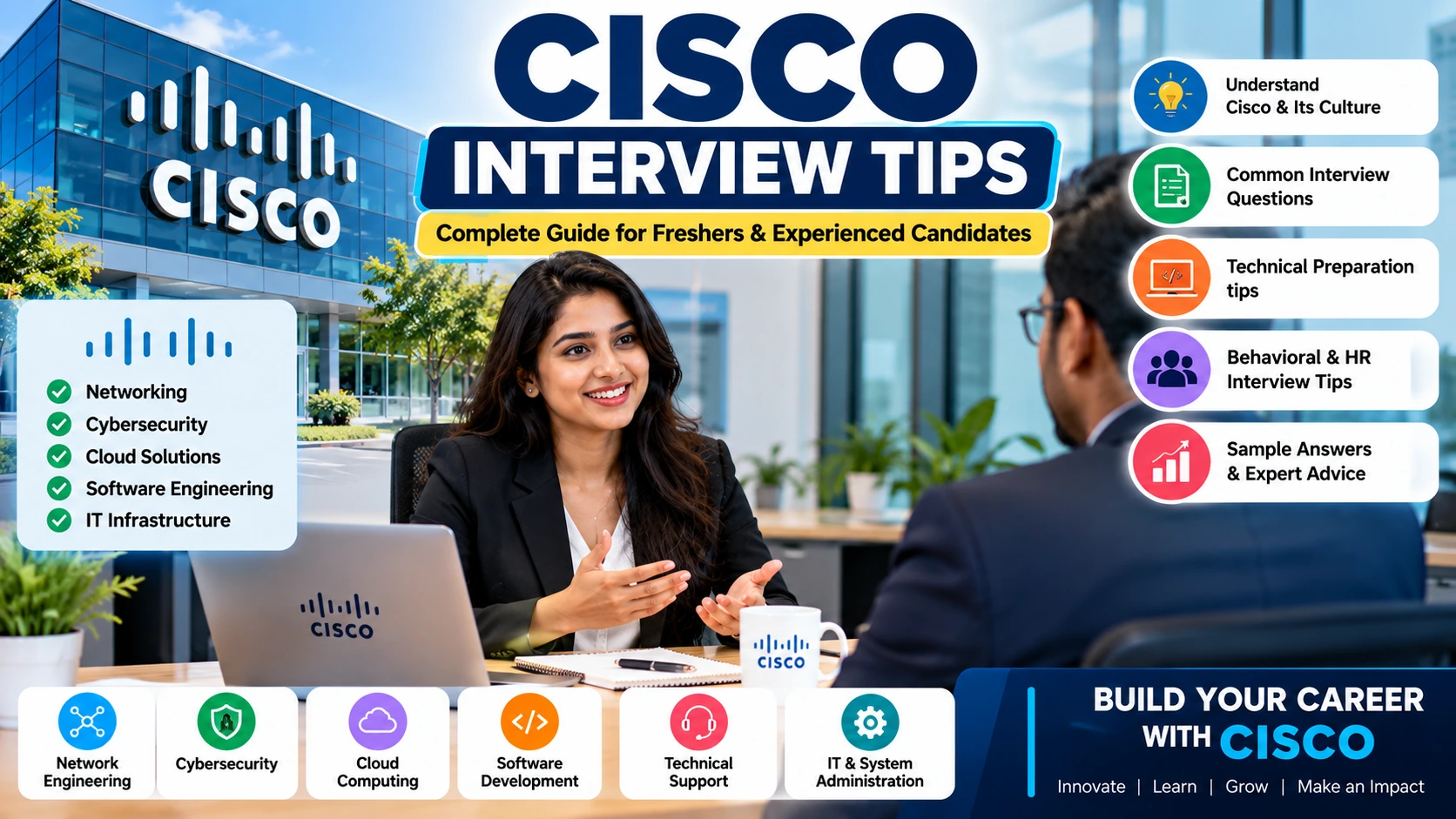
Cisco Interview Tips: Common Questions
Are you preparing for a Cisco interview? Whether you’re a fresher, an experienced professional, or a student applying for an internship, understanding the interview process can help you prepare with confidence.
Cisco is known for its work in networking, cybersecurity, cloud solutions, software, and IT infrastructure. Depending on the position, its interviews may assess your technical knowledge, problem-solving abilities, communication skills, and previous experience.
In this guide, AlexaHire covers Cisco interview tips, common practice questions, technical preparation, HR interview advice, and useful resources for candidates.
1. Understand the Cisco Interview Process
Cisco’s hiring process varies by role, team, location, and experience level. Depending on the position, candidates may go through some of the following stages:
- Application Screening: Recruiters review your application and qualifications against the job requirements.
- Recruiter Conversation: You may have an initial discussion about your background, interests, and the position.
- Technical Assessment: Some technical positions require a coding test, skills assessment, or another role-specific evaluation.
- Technical Interview: Engineering and IT candidates may discuss programming, networking, cybersecurity, system design, or other relevant topics.
- Behavioral Interview: Interviewers may ask about your academic projects, work experience, teamwork, and problem-solving approach.
- Final Review: The hiring team reviews interview feedback and determines the next steps.
Not every position includes all these stages. Your recruiter will explain the interview process for your particular role.
2. Research Cisco Before Your Interview
Before attending your interview, learn about Cisco’s business, products, and the team you are applying to join.
Consider researching:
- Cisco’s networking and cybersecurity solutions.
- Its cloud, collaboration, and software offerings.
- The responsibilities and qualifications in your job description.
- The technical tools and skills relevant to the position.
- Recent company announcements and developments.
- How your skills and experience relate to the role.
This preparation can help you answer questions such as “Why do you want to join Cisco?” with specific and meaningful details.
3. Common Cisco Interview Questions
The questions you encounter will depend on the position and interviewer. Use the following examples to practice.
General HR Interview Questions
- Tell me about yourself.
- Why do you want to work at Cisco?
- What do you know about Cisco?
- What are your strengths and weaknesses?
- Why are you interested in this particular role?
- How do you handle pressure and challenging situations?
- Where do you see yourself in the next five years?
- Tell me about a project or achievement you are proud of.
- How do you respond to feedback?
- What makes you a suitable candidate for this position?
Behavioral Interview Questions
- Tell me about a time you solved a challenging problem.
- Describe a situation where you worked successfully with a team.
- Give an example of a time you had to learn a new skill quickly.
- Tell me about a mistake you made and what you learned from it.
- Describe a situation where you had to meet a tight deadline.
- How have you handled a disagreement with a teammate?
- Tell me about a time you took initiative.
- Describe a project that did not go as planned. How did you respond?
These are practice questions, not a confirmed list of questions asked in Cisco interviews.
4. Technical Interview Preparation for Cisco
Technical preparation should match the job description. Review the fundamental concepts related to your position rather than trying to study every technical subject.
Networking and Network Engineering
If you’re applying for a networking position, review:
- OSI and TCP/IP models.
- IP addressing and subnetting.
- Routing and switching fundamentals.
- VLANs and network segmentation.
- DNS, DHCP, and common network protocols.
- Network troubleshooting.
- Basic network security concepts.
Practice explaining technical concepts in your own words and solving practical networking scenarios.
Software Engineering
For software development roles, prepare topics such as:
- Data structures and algorithms.
- Programming fundamentals.
- Object-oriented programming.
- Coding and debugging.
- Database fundamentals.
- Operating system concepts.
- System design, where relevant to the position.
- Projects and technical decisions from your own experience.
Practice coding problems and explain your approach clearly, including the reasoning behind your solution.
Cybersecurity
For cybersecurity-related positions, review the subjects listed in the job description. Depending on the role, these may include:
- Network security fundamentals.
- Common security threats and vulnerabilities.
- Authentication and access control.
- Security monitoring and incident response.
- Firewalls and intrusion detection.
- Security protocols and encryption basics.
- Relevant security tools and practical scenarios.
Technical Support and IT Roles
Candidates applying for technical support or IT positions can practice:
- Troubleshooting methods.
- Operating system fundamentals.
- Networking basics.
- Customer communication.
- Ticket management and issue prioritization.
- Explaining technical problems in simple language.
Prepare examples that show how you diagnose an issue, investigate its cause, and communicate the solution.
5. Cisco Interview Tips for Freshers
If you’re a fresher, your academic experience and personal projects can provide useful examples during an interview.
Here are some practical preparation tips:
- Prepare a concise self-introduction.
- Review your resume and be ready to discuss every listed skill.
- Understand the projects and assignments you have completed.
- Practice the fundamentals of your chosen technical field.
- Highlight internships, certifications, and relevant training.
- Explain what you learned from difficult assignments.
- Be honest about the areas where you need more experience.
- Demonstrate curiosity and a willingness to learn.
Cisco’s official entry-level career guidance also encourages candidates to highlight relevant skills, achievements, projects, and experiences beyond the classroom.
6. Use the STAR Method for Behavioral Questions
The STAR method helps you organize answers about your past experiences.
- Situation: Explain the background of the situation.
- Task: Describe the responsibility or challenge.
- Action: Explain the steps you personally took.
- Result: Share the outcome and what you learned.
Example question: Tell me about a time you solved a difficult problem.
Situation: During a college project, our team experienced a technical issue shortly before the submission deadline.
Task: I was responsible for investigating the issue and helping the team complete the project.
Action: I reviewed the project requirements, tested possible solutions, and coordinated with my teammates to resolve the problem.
Result: We completed the project on time and learned the importance of early testing and clear communication.
Use examples from your own education, work, internships, or personal projects rather than memorizing sample answers.
7. How to Prepare for a Cisco HR Interview
The HR interview is an opportunity to discuss your background, interests, and suitability for the role.
Before the interview:
- Review your resume and application.
- Prepare a clear answer to “Tell me about yourself.”
- Think about why the position interests you.
- Identify your key strengths and areas for improvement.
- Prepare examples of teamwork and problem-solving.
- Research the role and the organization.
- Prepare thoughtful questions for the interviewer.
Keep your answers relevant and natural. If you do not understand a question, politely ask for clarification.
8. Cisco Virtual Interview Tips
Some Cisco interviews take place online or over the phone. A little preparation can help you avoid unnecessary distractions.
- Test your internet connection and audio equipment.
- Choose a quiet location.
- Check your camera and lighting if the interview is on video.
- Keep your resume and job description accessible.
- Join the meeting a few minutes early.
- Speak clearly and organize your answers.
- Keep a notebook ready for important points.
- Follow the interview instructions provided by your recruiter.
For technical interviews, listen carefully to the problem statement and explain your reasoning as you work through it.
9. Questions to Ask Your Cisco Interviewer
At the end of the interview, you may have an opportunity to ask questions.
Consider asking:
- What are the main responsibilities of this position?
- What technical skills are most important for this team?
- What does a typical working day look like?
- How does the team approach learning and professional development?
- What are the next steps in the recruitment process?
Choose questions that are relevant to the role and have not already been answered during the interview.
10. Common Cisco Interview Mistakes to Avoid
Avoid these common mistakes during your preparation:
- Memorizing answers without understanding them.
- Ignoring the technical requirements of the job.
- Giving unclear explanations of your projects.
- Exaggerating your technical skills or achievements.
- Failing to explain your personal contribution to team projects.
- Neglecting communication and behavioral questions.
- Not asking for clarification when a question is confusing.
- Joining a virtual interview without checking your equipment.
A balanced preparation plan should cover technical knowledge, practical examples, and communication skills.
11. Cisco Interview Preparation Checklist
Use this checklist before your interview:
- Read the complete job description.
- Research Cisco and the relevant business area.
- Prepare your self-introduction.
- Review your resume, projects, and certifications.
- Practice common HR and behavioral questions.
- Review technical fundamentals for your role.
- Practice explaining your problem-solving approach.
- Confirm the interview time and format.
- Prepare questions for your interviewer.
- Check your internet connection and interview setup, if required.
Frequently Asked Questions (FAQs)
1. What questions are asked in a Cisco interview?
Questions vary by position. They may cover your background, technical knowledge, projects, communication, teamwork, and problem-solving skills. Technical roles may also include coding or other skills assessments.
2. Is the Cisco interview difficult for freshers?
The difficulty depends on the role and its requirements. Freshers can prepare by reviewing technical fundamentals, practicing common questions, and explaining their academic projects clearly.
3. How many rounds are there in a Cisco interview?
There is no fixed number of rounds for every position. The process varies by team, location, and job level. Your recruiter will share the stages relevant to your application.
4. What technical topics should I prepare for a Cisco interview?
Review the skills listed in your job description. Networking roles may require routing, switching, and IP addressing fundamentals, while software engineering roles may involve coding, algorithms, and programming concepts.
5. Does Cisco conduct interviews for freshers?
Cisco offers entry-level opportunities and internships for eligible candidates. The selection process and assessment requirements depend on the specific opening.
6. Where can I find official Cisco interview preparation resources?
Visit Cisco’s official careers website for information about its hiring process, entry-level opportunities, and interview preparation guidance.
Conclusion
Preparing for a Cisco interview starts with understanding the role and identifying the skills it requires. Review technical fundamentals, practice explaining your projects, and prepare genuine examples that demonstrate your problem-solving and communication abilities.
Whether you’re a fresher or an experienced professional, a structured preparation plan can help you approach your Cisco interview with greater confidence.
Explore more interview guides, career advice, and job opportunities on AlexaHire.in.
Official Resources:
- Cisco Hiring Process: https://careers.cisco.com/global/en/how-we-hire
- Cisco Entry-Level Careers: https://careers.cisco.com/global/en/entry-level-careers
- Cisco Engineering Careers: https://www.cisco.com/c/en/us/about/careers/job-areas/engineering.html
