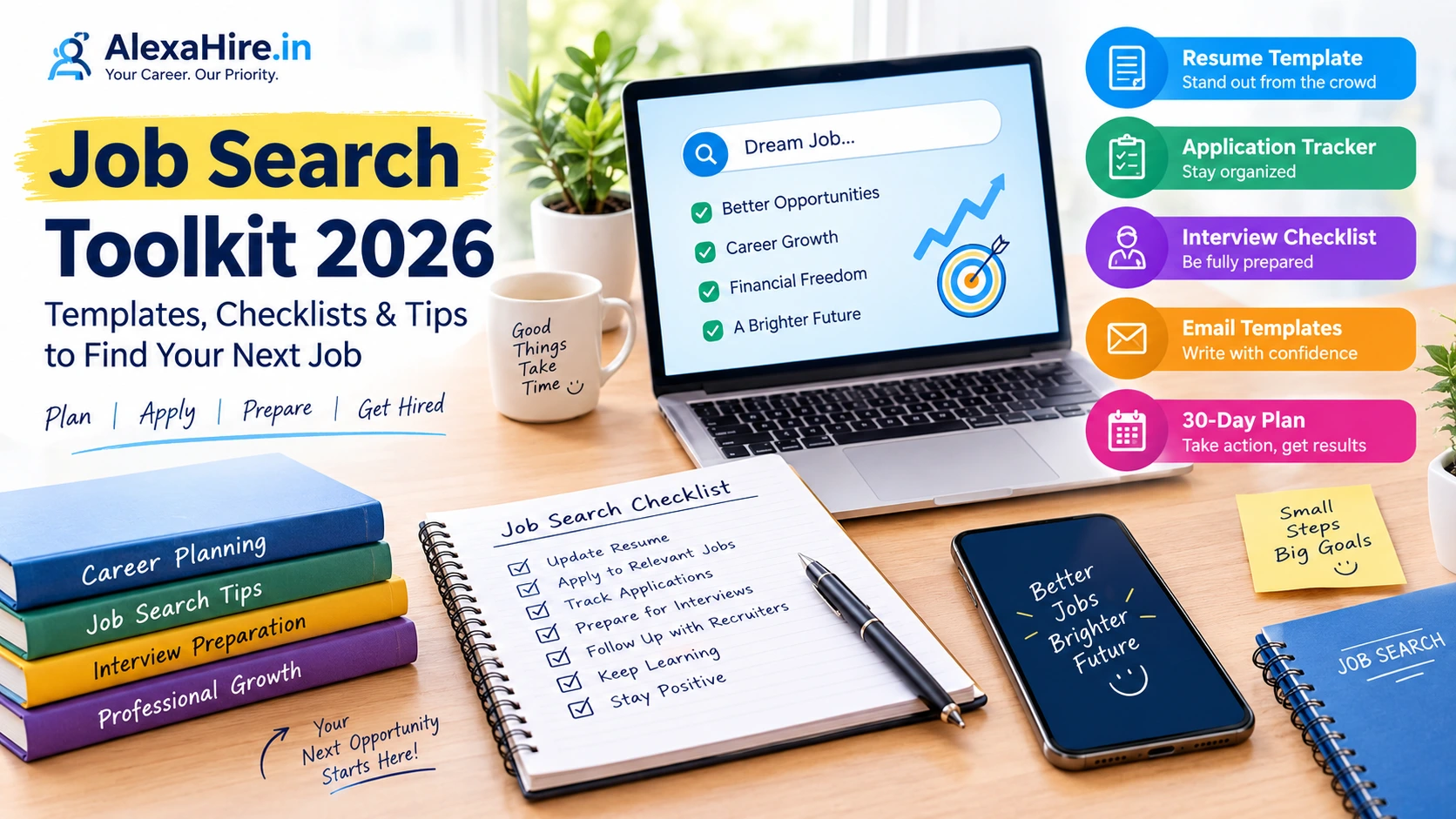
Job Search Toolkit 2026: Free Templates, Checklists and a Step-by-Step Plan to Find Your Next Job
Finding a job can be challenging, especially when you are applying to multiple companies, updating your resume, preparing for interviews, and waiting for recruiter responses.
Many job seekers make the mistake of applying randomly without maintaining a proper record. They sometimes forget application deadlines, miss follow-up opportunities, or struggle to prepare for interviews because they cannot find their previous notes.
A simple job search toolkit can help you organize the entire process. It brings your resume checklist, job application tracker, interview preparation notes, email templates, and daily action plan into one place.
Whether you are a fresher, an experienced professional, a college student looking for an internship, or someone planning a career change, this guide will help you build a more organized job search system.
What Is a Job Search Toolkit?
A job search toolkit is a collection of practical resources that helps you manage different stages of finding a job.
Instead of depending on memory or maintaining scattered notes, you can use templates and checklists to track your progress.
A useful toolkit includes:
- A job application tracker to record applications and their status.
- A resume checklist to review your CV before submitting it.
- An interview preparation worksheet to organize answers and company research.
- Email templates for contacting recruiters and following up.
- A networking message template for requesting referrals.
- A weekly planner to set job search targets.
- An offer evaluation checklist to compare opportunities.
These resources can be maintained in Google Sheets, Microsoft Excel, Google Docs, Microsoft Word, or a simple notebook.
1. Job Application Tracker Template
A job application tracker is one of the most useful tools for job seekers. It helps you remember which companies you applied to, when you applied, and what you need to do next.
You can create a spreadsheet using the following format.
| Company | Job Role | Application Date | Status | Next Action |
|---|---|---|---|---|
| Company A | Software Developer | 5 Oct | Applied | Check status |
| Company B | HR Executive | 7 Oct | Interview | Prepare answers |
| Company C | Data Analyst | 9 Oct | Shortlisted | Confirm interview |
| Company D | Customer Support | 10 Oct | No response | Review follow-up date |
The entries above are examples, not actual job openings.
Add columns for the official job link, location, recruiter contact, salary range, and follow-up date whenever relevant.
How to Use the Tracker
Step 1: Add a new row whenever you submit an application.
Step 2: Save the official job description link so you can review the requirements later.
Step 3: Update the status when you receive an email, interview invitation, rejection, or offer.
Step 4: Set a reminder for appropriate follow-ups.
Step 5: Review the tracker every week to identify your next actions.
This system helps you avoid duplicate applications and understand which job search methods are producing useful responses.
2. Resume Checklist Before Applying
Your resume should clearly communicate your qualifications, skills, and relevant experience. Before submitting it, review the following checklist.
Resume Quality Checklist
- Your name and contact details are correct.
- Your email address looks professional.
- Your resume matches the job you are applying for.
- Your skills reflect the actual requirements of the role.
- Your work experience includes relevant achievements.
- Your projects explain what you did and which tools you used.
- Your education details and dates are accurate.
- Your grammar, spelling, and formatting have been checked.
- Your resume is easy to read on a computer screen.
- Your file name is professional, such as
YourName_Resume.pdf. - Your resume contains no invented qualifications or experience.
How to Improve Your Resume
Avoid sending the same resume to every employer. Review each job description and identify the skills and responsibilities that genuinely match your background.
For example, if a data analyst role requires Excel, SQL, and reporting, highlight your relevant experience with those skills if you have them.
Instead of writing only “Responsible for reports,” explain the work you completed and its result.
A stronger example might be: “Prepared weekly sales reports in Excel to help the team monitor performance and identify trends.”
Use measurable results where you have accurate figures. Never invent achievements simply to make your resume look impressive.
3. Job Application Email Template
A professional email can help you communicate clearly when applying directly to a company or contacting a recruiter.
Use this template as a starting point.
Subject: Application for [Job Title] – [Your Name]
Dear Hiring Manager,
I am writing to apply for the position of [Job Title] at [Company Name].
I have experience or relevant knowledge in [mention your relevant skills, education, or experience]. I believe my background aligns with the requirements of this position.
Please find my resume attached for your consideration. I would appreciate the opportunity to discuss my qualifications and suitability for the role.
Thank you for your time.
Best regards,
[Your Name]
[Phone Number]
[LinkedIn Profile, if relevant]
Important tip: Personalize the email for each employer and check that you have attached the correct resume before sending it.
4. Interview Preparation Checklist
Receiving an interview invitation is an important step. Proper preparation can help you explain your experience and demonstrate your suitability for the role.
Use this checklist before every interview.
- Read the job description carefully.
- Research the company’s products, services, and business.
- Review your resume and be ready to discuss every major detail.
- Prepare your answer to “Tell me about yourself.”
- Practise questions about your strengths and relevant skills.
- Prepare examples of projects, achievements, or challenges.
- Review the technical or role-specific topics mentioned in the job description.
- Prepare two or three thoughtful questions for the interviewer.
- Confirm the interview time, format, and location.
- Test your internet connection, microphone, and camera for online interviews.
- Keep your resume and any required documents ready.
Use the STAR Method for Behavioural Questions
The STAR method helps you structure answers about situations you have handled.
- S – Situation: Explain the background.
- T – Task: Describe your responsibility.
- A – Action: Explain what you did.
- R – Result: Share the outcome.
For example, if an interviewer asks how you handled a difficult deadline, describe the situation, your responsibility, the steps you took, and the result.
Freshers can use genuine examples from college projects, internships, volunteering, or other relevant experiences.
5. Recruiter Follow-Up Email Template
Sometimes you may not receive an update immediately after applying or attending an interview. A polite follow-up can help you ask about the status of your application without sounding demanding.
Subject: Follow-Up on [Job Title] Application
Dear [Recruiter’s Name],
I hope you are doing well.
I am writing to follow up on my application for the position of [Job Title] at [Company Name], submitted on [Date].
I remain interested in this opportunity and would appreciate any update you can share regarding the hiring process.
Thank you for your time and consideration.
Best regards,
[Your Name]
Follow the timeline communicated by the recruiter whenever possible. If no timeline was provided, allow a reasonable amount of time before following up. Avoid sending repeated messages within a short period.
6. Networking and Referral Message Template
Networking can help you learn about relevant opportunities and understand what employers expect from candidates.
You can connect with professionals through LinkedIn, alumni groups, professional communities, and industry events.
Here is a short message you can personalize.
LinkedIn Message
Hello [Name],
I came across your profile while learning more about opportunities in [Industry or Job Function]. I am interested in roles related to [Target Role] and would appreciate any advice you may be able to share.
If your organization has a suitable opening, I would be grateful if you could point me toward the official job posting.
Thank you for your time.
Best regards,
[Your Name]
Keep your message brief, respectful, and specific. If you request a referral, share the relevant job link and a concise explanation of why your background matches the role. A referral is never a guarantee of an interview or job offer.
7. Weekly Job Search Planner
A job search becomes easier to manage when you divide it into small, achievable tasks.
Use this sample weekly plan and adjust it to your availability.
| Day | Main Activity |
|---|---|
| Monday | Find suitable job openings and shortlist companies |
| Tuesday | Customize your resume and submit applications |
| Wednesday | Practise interview questions and review relevant skills |
| Thursday | Contact recruiters and build professional connections |
| Friday | Check application statuses and send appropriate follow-ups |
| Saturday | Improve your skills and work on projects |
| Sunday | Review progress and plan the following week |
You do not need to follow this schedule exactly. If you have a full-time job, college classes, or family responsibilities, set smaller daily targets that fit your routine.
The goal is consistency rather than applying to as many jobs as possible.
8. How to Find Relevant Jobs More Efficiently
Searching for jobs becomes more productive when you know which positions match your qualifications.
Use Multiple Job Search Channels
Explore official company career pages, reputable job portals, LinkedIn, professional communities, and referrals.
For example, you can use:
- LinkedIn Jobs
- Alexahire.in
- Naukri
- Indeed India
- National Career Service
- Official company career websites
Search with Specific Keywords
Instead of searching only for “jobs,” use your target role, skills, experience level, and preferred location.
Examples include:
- Fresher Data Analyst Jobs
- Work From Home Customer Support Jobs
- Entry-Level HR Executive Jobs
- Junior Software Developer Jobs
- Remote Digital Marketing Jobs
Read the complete job description before applying. Check the experience requirements, work location, employment type, and application deadline.
Verify Every Job Opportunity
Be cautious of recruiters who demand money for interviews, guaranteed placements, or job offers. Verify the employer, use official application channels, and avoid sharing sensitive financial information with unverified contacts.
A well-organized job search should protect both your time and your personal information.
9. Compare Job Offers Before Accepting
If you receive more than one offer, compare the full package rather than looking only at the headline salary.
Consider these factors:
- Fixed salary and variable compensation
- Expected take-home pay
- Job responsibilities and learning opportunities
- Work location and commuting costs
- Remote, hybrid, or office-based arrangements
- Working hours and leave policies
- Health benefits and other employment benefits
- Career growth and training opportunities
Read the offer letter carefully and clarify any unclear conditions before accepting.
A job with a slightly lower salary may still be a better fit if it provides valuable experience, suitable working hours, and stronger long-term opportunities. The right choice depends on your priorities and circumstances.
10. A Simple 30-Day Job Search Action Plan
If you are unsure where to begin, use this four-week plan.
Week 1: Prepare
Update your resume, define your target roles, identify suitable companies, and create your application tracker.
Week 2: Apply
Search official job postings, tailor your resume to suitable opportunities, and submit applications that match your qualifications.
Week 3: Connect and Practise
Contact relevant professionals, prepare interview examples, review role-specific skills, and practise answering common questions.
Week 4: Review and Improve
Check your application statuses, follow up where appropriate, identify gaps in your skills or resume, and refine your strategy based on the responses you receive.
At the end of 30 days, review the number of relevant applications submitted, recruiter responses, interviews received, and skills improved. Use these results to plan your next month.
Remember that hiring timelines vary. This plan provides structure but does not guarantee an interview or job offer within 30 days.
Frequently Asked Questions (FAQs)
1. What is a job search toolkit?
A job search toolkit is a collection of templates, checklists, trackers, and planning resources that help candidates manage applications, improve resumes, prepare for interviews, and communicate with recruiters.
2. What should a job application tracker include?
It should include the company name, job title, application date, official job link, application status, recruiter details when available, and the next follow-up date.
3. Are job search templates useful for freshers?
Yes. Freshers can use resume checklists, application trackers, interview worksheets, and email templates to organize their search and communicate more professionally.
4. How many jobs should I apply for each day?
No fixed number works for everyone. Focus on finding suitable openings and submitting accurate, tailored applications rather than sending large numbers of generic applications.
5. How can I prepare for an interview quickly?
Read the job description, research the employer, review your resume, practise common questions, prepare relevant examples, and confirm the interview details.
6. Where can I find legitimate job openings?
Start with official company career pages, reputable job portals, professional networks, and trusted government employment resources. Verify the job details before sharing personal information.
7. Can a job search toolkit guarantee a job?
No. A toolkit helps you stay organized and prepare more effectively, but hiring decisions depend on several factors, including your qualifications, skills, interview performance, and the employer’s requirements.
Conclusion
A successful job search requires more than sending resumes to different companies. You need a clear plan, accurate application records, a well-prepared resume, strong interview preparation, and professional communication.
Using a job search toolkit can help you manage these tasks in one organized system. Start with a simple tracker, review your resume before every application, prepare for interviews in advance, and follow up professionally.
Whether you are a fresher, an experienced professional, or someone planning a career change, consistent preparation can make your job search more focused and manageable.
Visit AlexaHire.in for more career advice, job opportunities, resume tips, interview preparation guides, and remote work resources.
