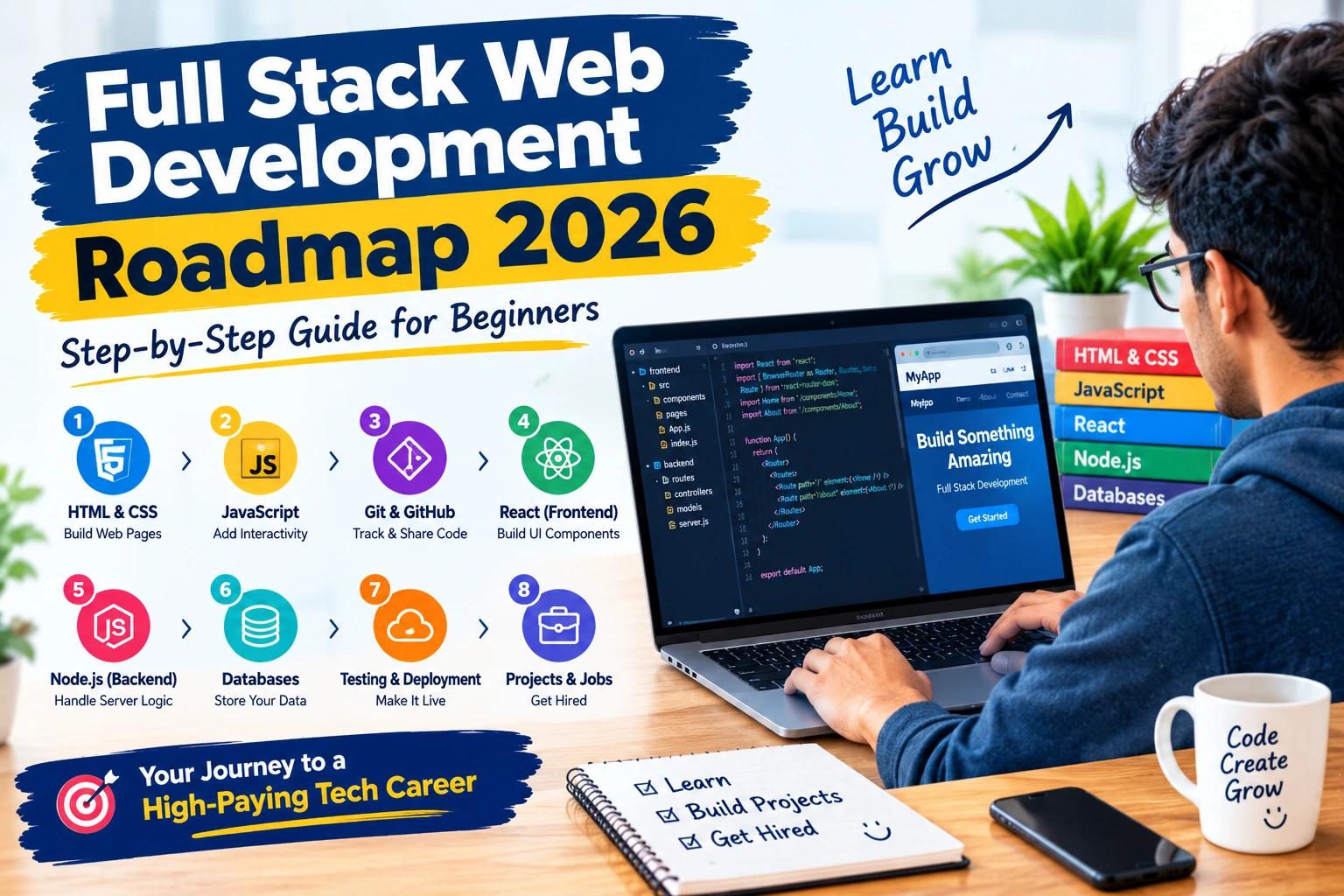
Full Stack Web Development Roadmap 2026: A Step-by-Step Guide for Beginners
Are you planning to become a full-stack web developer in 2026? Full-stack web development is a career path that allows you to build complete websites and web applications, from the user interface to the server and database.
The good news is that beginners can start learning these skills without an expensive degree or paid course. However, becoming job-ready requires consistent practice, a strong understanding of programming fundamentals and real-world projects.
In this guide, we will explain the full stack web development roadmap for 2026, including the technologies to learn, projects to build, and steps to prepare for developer jobs.
What Is Full Stack Web Development?
Full stack web development involves working on both the frontend and backend of a website or application.
Frontend development covers the parts users see and interact with, such as buttons, forms, navigation menus, and page layouts.
Backend development manages server-side logic, authentication, data processing, and communication with databases.
A full stack developer understands how these parts work together to deliver a complete application.
Step 1: Learn HTML and CSS
HTML and CSS are the starting points for web development. HTML provides the structure of a webpage, while CSS controls its appearance and layout.
Topics to learn:
- HTML elements, headings, links and forms
- Semantic HTML and accessibility
- CSS selectors, colours, spacing and typography
- Flexbox and CSS Grid
- Responsive web design for mobile devices
Practice project: Build a personal portfolio website with an About section, skills, projects, and contact information.
Start with the free MDN Learn Web Development curriculum to understand the fundamentals.
Step 2: Master JavaScript
JavaScript makes websites interactive. It allows developers to validate forms, respond to user actions, update content and communicate with external APIs.
Learn these concepts:
- Variables, data types and operators
- Functions, arrays and objects
- Conditions and loops
- DOM manipulation and events
- Promises, async/await and API requests
- ES modules and error handling
Practice project: Create a to-do list, calculator or weather application using JavaScript.
Do not rush through this stage. A strong JavaScript foundation will make learning modern frameworks much easier.
Step 3: Learn Git and GitHub
Git helps developers track changes in their code, while GitHub allows them to host repositories and collaborate with other developers.
Learn how to create repositories, commit changes, use branches, resolve simple conflicts and write useful README files.
Upload your projects to GitHub as you progress. A well-organised repository can help employers understand your coding experience and project work.
Step 4: Learn React and TypeScript
After learning JavaScript, choose a frontend framework or library. React is a popular option for building interactive user interfaces.
Focus on:
- Components, props, and state
- React Hooks
- Forms and validation
- Routing and reusable components
- Fetching data from APIs
- TypeScript fundamentals
TypeScript adds type checking to JavaScript and can help developers write more maintainable applications.
Practice project: Build a multi-page job portal interface with search, filters, job details, and an application form.
You can also explore Next.js after understanding React basics.
Step 5: Choose a Backend Technology
The backend processes requests, manages application logic, and communicates with databases. You do not need to learn every backend language at once. Choose one technology stack and understand it properly.
Popular options include:
- Node.js with Express: Suitable for developers using JavaScript across the frontend and backend.
- Python with Django or FastAPI: Useful for web applications and API development.
- Java with Spring Boot: Common in enterprise application development.
- C# with ASP.NET Core: Another option for building business applications.
Learn HTTP requests, REST APIs, authentication, input validation, error handling, and basic security.
Practice project: Build a backend API that lets users register, log in, create records, and update information.
Step 6: Learn Databases and SQL
Web applications often need to store user accounts, products, job listings, and other information. Databases make this possible.
Start with a relational database such as PostgreSQL or MySQL. Learn SQL queries, filtering, joins, relationships, constraints, and basic database design.
You can explore MongoDB later if your chosen project or job requirements call for a document database.
Practice project: Create a job listings database with company names, job titles, locations, and application links. Connect it to your backend API.
Step 7: Learn Testing, Security and Deployment
Writing code is only part of building an application. You also need to check that it works correctly and can be used safely.
Important topics include:
- Unit and integration testing
- Authentication and authorisation
- Password hashing and secure configuration
- Input validation and common web vulnerabilities
- Environment variables and error logging
- Deployment and basic performance monitoring
Learn how to deploy a project using a suitable hosting platform. You can also explore Docker and basic CI/CD once you understand application development.
A live project that people can actually use is a stronger demonstration of your skills than a project that exists only on your computer.
Full Stack Web Development Roadmap: Quick Overview
| Learning stage | Main skills |
|---|---|
| 1. Web fundamentals | HTML, CSS, responsive design |
| 2. Programming | JavaScript, APIs, async/await |
| 3. Developer tools | Git and GitHub |
| 4. Frontend | React, TypeScript |
| 5. Backend | Node.js, Python, Java or C# |
| 6. Database | SQL, PostgreSQL or MySQL |
| 7. Job-ready skills | Testing, security, deployment and projects |
How Long Does It Take to Become a Full Stack Developer?
Your learning time depends on your starting point, daily practice and project experience.
As a rough planning estimate, someone starting from zero may need around 6–12 months of consistent learning to build a useful portfolio and prepare for entry-level opportunities. Some learners progress faster, while others need more time.
Focus on understanding concepts instead of completing courses as quickly as possible.
Best Projects to Build for Your Portfolio
Try to complete two or three original projects that demonstrate your ability to build an application from start to finish.
Consider these ideas:
- Job Portal: Add job search, filters, job details and an application form.
- E-commerce Website: Include product pages, a shopping cart and order management.
- Task Management App: Add user accounts, task creation, editing and status updates.
Use GitHub to document your code and provide a live demo where possible. Be prepared to explain your technical decisions and the problems you solved.
How to Get Your First Full Stack Developer Job
Once you have learned the fundamentals and built projects, prepare for the hiring process.
- Create a clear, ATS-friendly resume.
- Add your GitHub profile and live project links.
- Practise JavaScript, programming fundamentals and basic data structures.
- Revise SQL, APIs, authentication and debugging.
- Apply for internships, trainee roles and junior developer positions.
- Practise explaining your projects in simple, clear language.
Keep learning from official documentation and practical exercises. You can also use freeCodeCamp for structured coding practice.
Conclusion
The full stack web development roadmap for 2026 begins with HTML, CSS and JavaScript, followed by Git, a frontend framework, backend development, databases, testing and deployment.
You do not need to learn every technology available. Choose one stack, build practical projects and gradually improve your skills.
With consistent practice and a strong portfolio, you can prepare for internships and entry-level web development opportunities. For more career guides, job updates and skill-building resources, visit AlexaHire.in.
Frequently Asked Questions (FAQs)
1. Can beginners learn full stack web development in 2026?
Yes. Beginners can start with HTML, CSS and JavaScript, then gradually learn frontend frameworks, backend technologies and databases.
2. Which stack is best for a beginner?
JavaScript with React, Node.js and a database is one possible path. Python with Django or Java with Spring Boot can also be suitable, depending on your interests and target jobs.
3. Is a degree necessary to become a full stack developer?
A degree can help with eligibility for some positions, but practical skills, project experience and problem-solving ability are also important. Individual employers may have different education requirements.
4. Is full stack development difficult to learn?
It can be challenging because it covers several areas of software development. Learning one topic at a time and building small projects can make the process easier.
5. What should I learn after completing a full stack course?
Build original projects, learn testing and deployment, practise programming problems and prepare for technical interviews. Continue improving the areas most relevant to your target roles.