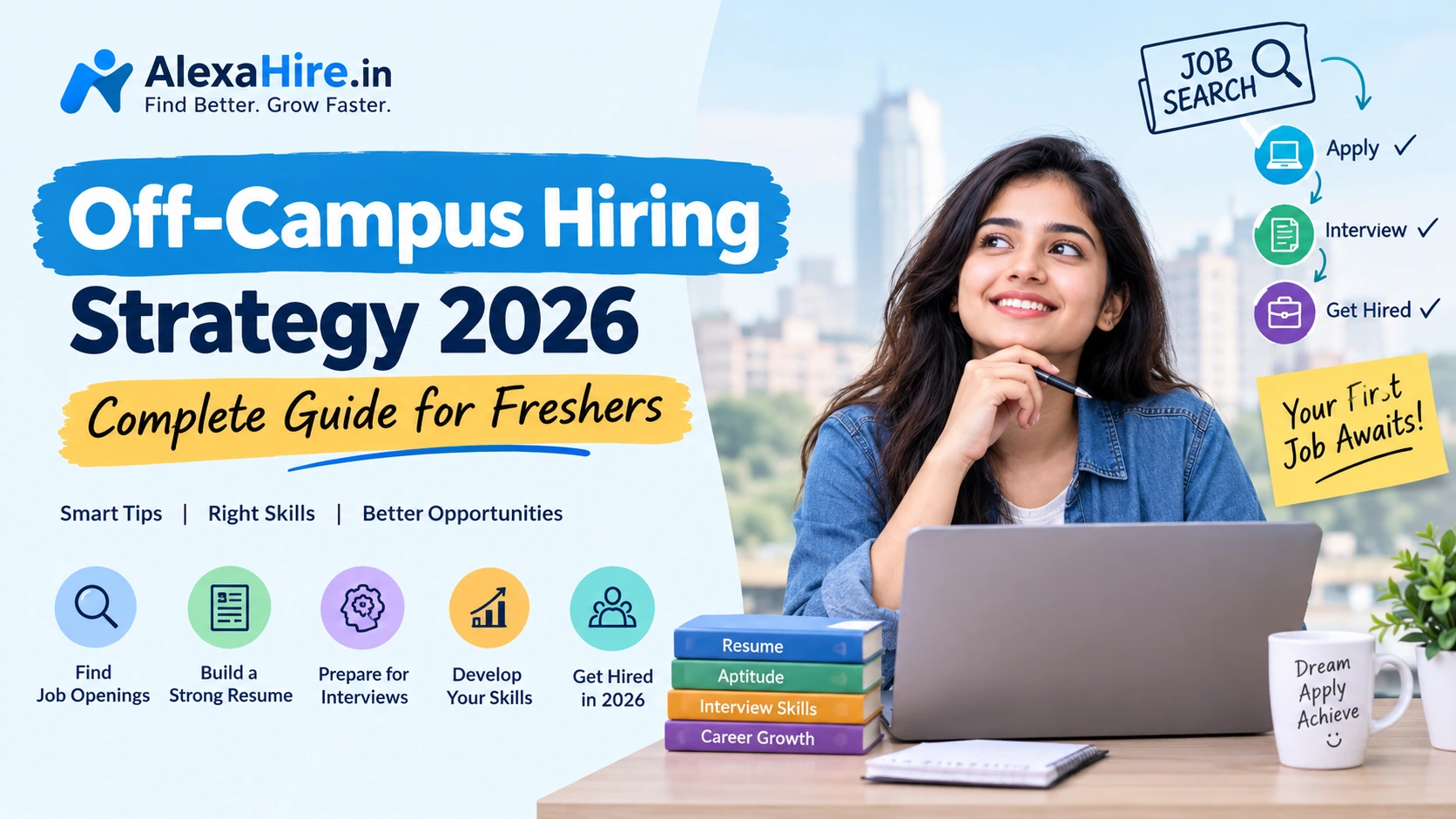
Off-Campus Hiring Strategy 2026: Complete Guide for Freshers
Are you a fresher looking for your first job but have not received an offer through campus placement? Do not worry. You can still apply directly to companies through off-campus hiring.
In 2026, fresh graduates can explore job opportunities through company career websites, job portals, referrals, internships and open recruitment drives. However, finding a job requires more than sending the same resume to hundreds of companies. You need a clear strategy, relevant skills and regular preparation.
In this guide, AlexaHire explains the best off-campus hiring strategy for 2026 to help freshers find suitable jobs, prepare for recruitment tests and improve their chances of getting interview calls.
What Is Off-Campus Hiring?
Off-campus hiring is a recruitment process in which candidates apply for jobs independently rather than through their college placement cell. Companies may conduct online assessments, virtual interviews, walk-in interviews or direct recruitment drives.
Freshers from B.Tech, BCA, MCA, B.Sc, B.Com, BBA and other degree programmes can explore off-campus opportunities, depending on the eligibility requirements of each position.
Companies such as TCS, Infosys, Wipro, Accenture, Cognizant and Capgemini may offer entry-level opportunities through their recruitment channels. Availability, eligible graduation batches and selection criteria vary by vacancy.
1. Find Jobs Through the Right Channels
The first step is to identify reliable sources of job openings. Do not depend on only one website or social media group.
Here are some useful places to search:
- Company career websites: Check the official career pages of your target employers for graduate programmes, trainee roles and entry-level vacancies.
- LinkedIn Jobs: Search for fresher jobs, graduate trainee positions and entry-level opportunities.
- Naukri: Create a complete profile and set job alerts based on your skills and qualifications.
- Indeed and Foundit: Explore relevant vacancies and compare their eligibility requirements.
- AlexaHire.in: Follow job listings, recruitment updates and career advice to discover opportunities.
Always verify a vacancy on the employer’s official website before submitting your application.
2. Create a Professional, Job-Specific Resume
Your resume is an important part of the recruitment process. A generic resume may not highlight the skills a particular employer needs.
Create a clear, preferably one-page resume if you are a fresher. Include your contact details, educational qualifications, relevant skills, academic projects, internships and certifications.
Customise your resume for each role. For example, a software developer application should highlight programming skills and technical projects, while a finance role may require Excel, accounting knowledge and analytical abilities.
Use standard headings, readable formatting and relevant keywords from the job description. Never add false qualifications or experience.
3. Prepare for Aptitude Tests and Technical Interviews
Many entry-level recruitment processes include online assessments. Depending on the role, these may test quantitative aptitude, logical reasoning, verbal ability, coding or subject knowledge.
Follow a regular preparation schedule:
- Practise aptitude questions every day.
- Revise basic mathematics and logical reasoning.
- Improve English grammar, comprehension and communication.
- For technical roles, revise programming fundamentals and practise coding problems.
- Prepare to explain every project and skill mentioned in your resume.
For non-technical positions, focus on role-related knowledge, computer skills, communication and customer-handling scenarios.
The exact selection process differs between employers, so read the recruitment instructions carefully.
4. Build Practical Skills and Projects
A degree is important, but employers may also want evidence that you can apply your knowledge.
Freshers can build small projects relevant to their chosen career. For example, a computer science graduate can create a website or a simple application. A commerce graduate can prepare an Excel dashboard or a sample financial analysis project.
You can also complete relevant courses, participate in internships and develop practical skills using free learning resources.
Keep your projects organised and be ready to explain the problem, your approach, the tools you used and what you learned.
5. Use LinkedIn and Employee Referrals
Networking can help you learn about vacancies and understand a company’s recruitment process.
Create a professional LinkedIn profile with your education, skills, projects and career interests. Connect respectfully with alumni, recruiters and professionals working in your target field.
When contacting someone, introduce yourself briefly, mention the relevant role and ask a specific question. If appropriate, you can request a referral after establishing a professional connection.
A referral does not guarantee an interview or job offer, but it can be another useful route to explore.
6. Apply Consistently and Track Your Applications
Do not apply randomly or lose track of the positions you have already applied for.
Create a spreadsheet containing the company name, job title, application link, date of application, eligibility criteria and current status.
Set a realistic weekly target for relevant applications. For example, you could aim to submit three to five carefully matched applications each day, depending on your schedule and the availability of suitable roles.
Review your progress every week. If you are not receiving responses, improve your resume, check whether you meet the eligibility criteria and refine your job search.
7. Avoid Common Off-Campus Hiring Mistakes
Many candidates reduce their chances by making avoidable mistakes.
- Applying without checking the required degree or graduation year.
- Sending an outdated or irrelevant resume.
- Ignoring aptitude tests and interview preparation.
- Missing application deadlines.
- Depending entirely on social media job posts.
- Paying someone who promises a guaranteed job.
Important: Be careful with recruitment scams. Never pay a recruiter for a guaranteed job offer. Verify company email addresses, application links and interview invitations before sharing personal information.
30-Day Off-Campus Hiring Action Plan
Week 1: Prepare your resume, select target roles, and create profiles on relevant job portals.
Week 2: Apply to suitable vacancies, practise aptitude questions, and revise role-specific skills.
Week 3: Improve your projects, connect with relevant professionals, and practise mock interviews.
Week 4: Continue applying, review your application tracker and work on areas where you need improvement.
This plan provides structure, but the time required to secure a job depends on your skills, eligibility, market conditions, and the number of suitable openings.
Frequently Asked Questions (FAQs)
1. Can freshers get jobs through off-campus hiring in 2026?
Yes. Freshers can apply through official company career pages, job portals, recruitment drives, referrals and graduate hiring programmes, provided they meet the requirements.
2. Which companies offer off-campus jobs for freshers?
Companies such as TCS, Infosys, Wipro, Accenture, Cognizant and Capgemini may advertise entry-level opportunities. Check their official career websites for current vacancies and eligibility details.
3. Is experience necessary for off-campus jobs?
Not always. Many graduate trainee and entry-level roles accept candidates without full-time work experience. Relevant projects, internships, and skills can strengthen your application.
4. How can I find genuine off-campus drives?
Start with official company career pages. Use job portals and trusted job websites to discover openings, then verify the vacancy and application link before applying.
5. Can non-technical graduates apply for off-campus jobs?
Yes. Depending on the eligibility criteria, graduates can explore roles in customer support, finance, sales, operations, human resources, administration, and other business functions.
Conclusion
A successful off-campus hiring strategy in 2026 starts with choosing the right roles, preparing a professional resume and developing relevant skills. Combine regular applications with interview preparation, networking and careful verification of job openings.
Do not get discouraged if your first few applications do not lead to interviews. Review your approach, learn from feedback, and continue applying consistently.
Visit AlexaHire.in for more fresher job updates, recruitment guides, resume tips, and interview preparation resources to support your career journey.