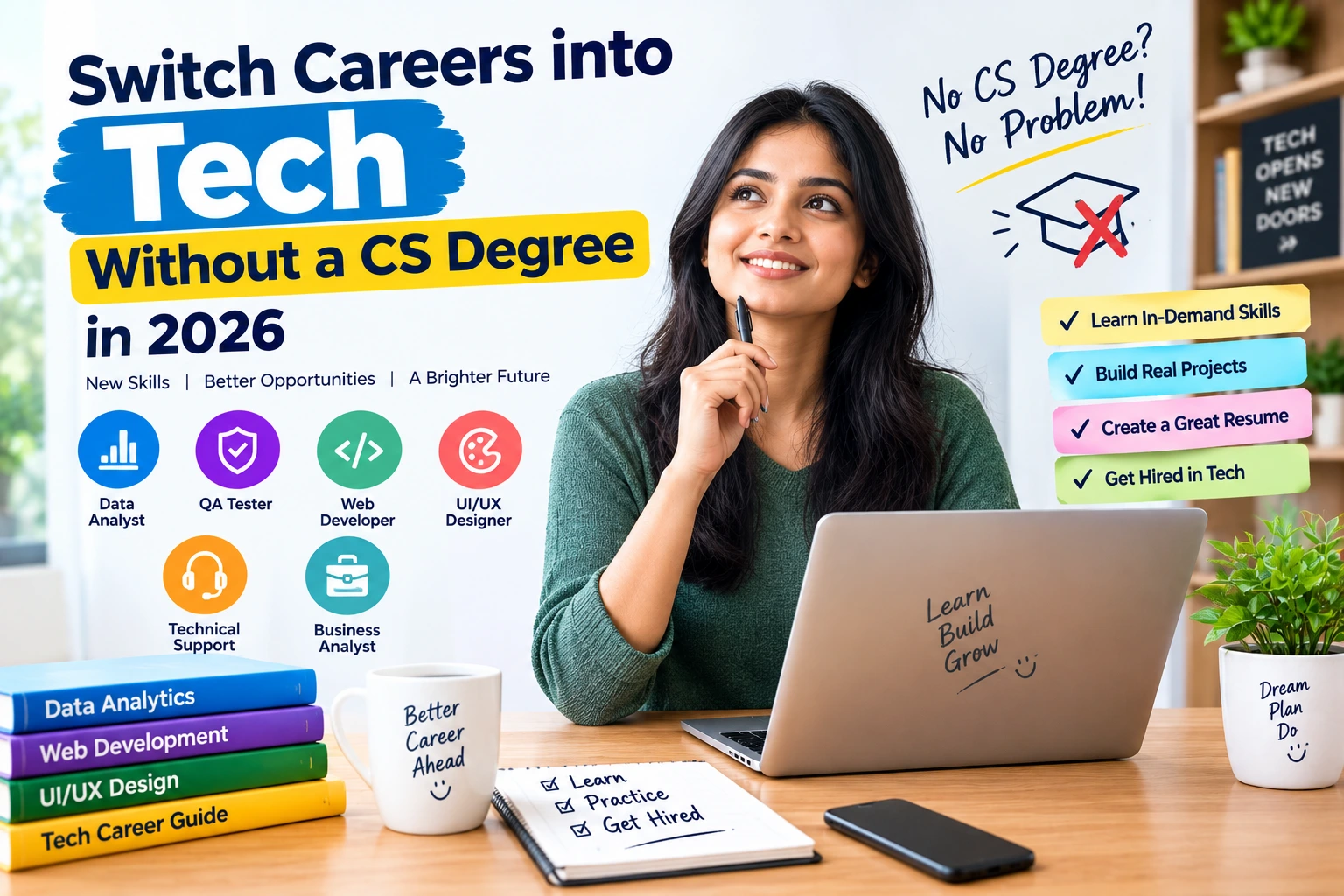
How to Switch Careers into Tech Without CS Degree in 2026
Do you want to build a career in the technology industry but do not have a Computer Science (CS) degree? You are not alone. Many graduates from commerce, arts, science, management, and other backgrounds want to enter the IT industry but are unsure where to begin.
The good news is that a computer science degree is not mandatory for every technology job. Employers may consider candidates with relevant skills, practical projects, certifications, and problem-solving abilities, depending on the role and their hiring requirements.
Whether you are a fresher or a working professional, you can start preparing for a tech career by learning the right skills and following a clear career plan. In this guide, AlexaHire explains how to switch careers into tech without a CS degree in 2026.
Can You Get a Tech Job Without a Computer Science Degree?
Yes, it is possible to enter the technology industry without a CS degree. However, your chances depend on the job role, your existing qualifications, the employer’s requirements, and your practical knowledge.
Some companies require a specific technical degree, while others consider candidates from different educational backgrounds for suitable positions.
Instead of learning every technology at once, choose one career path and focus on developing the skills required for that role.
6 Best Tech Careers for Non-CS Graduates
1. Data Analyst
Data analytics is a useful career option for people who enjoy working with numbers, reports, and business information. Commerce, mathematics, economics, and business graduates may find their existing knowledge helpful.
Skills to learn: Excel, SQL, Power BI, data visualisation, and basic statistics.
Beginner project: Create a sales dashboard using sample business data and explain the key findings.
2. Software Tester or QA Analyst
Software testers check websites and applications for errors before products are released. This role can suit candidates who pay attention to detail and enjoy finding and solving problems.
Skills to learn: Manual testing, test cases, bug reporting, software development basics, and eventually automation tools such as Selenium or Playwright.
Beginner project: Test a sample website, document the bugs you find, and prepare a test report.
3. Web Developer
Web development is an option for candidates who want to build websites and web applications. A CS degree is not the only route into this field, but you must learn programming fundamentals and practise regularly.
Skills to learn: HTML, CSS, JavaScript, Git, and a framework such as React.
Beginner project: Build a personal portfolio website that displays your skills, projects, and contact information.
4. UI/UX Designer
UI/UX designers work on the appearance, usability, and overall experience of websites and applications. People with backgrounds in design, communication, psychology, or creative fields may find this career interesting.
Skills to learn: Figma, wireframing, prototyping, user research, and usability testing.
Beginner project: Redesign a simple mobile app screen and explain how your design improves the user experience.
5. Technical Support Specialist
Technical support professionals help users resolve software, hardware, account, and connectivity problems. This can be a practical starting point for candidates who have good communication skills and enjoy troubleshooting.
Skills to learn: Operating systems, networking basics, ticketing systems, troubleshooting, and customer communication.
Beginner project: Prepare a troubleshooting guide for common computer or software problems.
6. Business Analyst
Business analysts help organisations understand business requirements, improve processes, and communicate with technical teams. Candidates with commerce, management, finance, and operations experience may have a useful foundation.
Skills to learn: Excel, requirements gathering, process mapping, documentation, SQL basics, and data interpretation.
Beginner project: Analyse a sample business process and recommend improvements using a simple report.
Step-by-Step Roadmap to Switch into Tech
Changing careers becomes easier when you follow a structured plan instead of jumping between unrelated courses.
Step 1: Choose One Career Path
Select a role based on your interests and existing strengths. For example, choose data analytics if you enjoy numbers, UI/UX design if you like creative work, or web development if you want to learn programming.
Step 2: Learn the Required Skills
Use online tutorials, documentation, practical exercises, and structured courses. You do not need to purchase an expensive course immediately. Start with free learning resources and invest in paid training only if it offers clear value.
Step 3: Build Practical Projects
Employers need evidence that you can perform the work. Build two or three relevant projects and explain the problem, your approach, the tools you used, and the results.
Step 4: Create a Job-Ready Resume
Highlight your transferable skills, previous work experience, projects, and relevant certifications. Avoid presenting yourself as someone with no experience if your previous career has taught you useful skills such as communication, analysis, customer service, or project coordination.
Step 5: Apply for Entry-Level Opportunities
Search for junior positions, internships, trainee programmes, and career-transition opportunities. Read each job description carefully because some vacancies require specific degrees or prior experience.
Step 6: Prepare for Interviews
Practise role-specific questions and explain your projects confidently. Be ready to discuss why you are changing careers and how your previous experience can benefit the employer.
How Long Does It Take to Switch to Tech?
The timeline depends on your starting point, chosen role, available study time, and consistency.
A focused learner may develop beginner-level skills within a few months, but becoming competitive for a job can take longer. Programming-heavy positions generally require substantial practice, while some entry-level support and design-related roles may have different learning requirements.
A practical starting target is to study for one to two hours daily, build projects regularly, and review real job descriptions to understand employer expectations. There is no guaranteed timeline for getting hired.
Common Mistakes to Avoid
Many career changers lose time by learning several programming languages simultaneously or collecting certificates without practical experience.
Avoid these mistakes:
- Switching between career paths every few weeks.
- Depending entirely on video tutorials without practising.
- Applying for jobs without checking eligibility requirements.
- Ignoring communication and interview preparation.
- Paying recruiters who promise guaranteed jobs.
- Believing that a short course guarantees a high-paying position.
Focus on building useful skills and demonstrating your ability through real projects.
Final Thoughts
Switching careers into tech without a CS degree is possible if you choose a suitable role, learn relevant skills, and build practical experience. Data analytics, software testing, web development, UI/UX design, technical support, and business analysis are potential pathways for candidates from different educational backgrounds.
Your previous degree and professional experience can still be valuable. The key is to combine your existing strengths with the technical skills employers expect.
Start with one career path, build a small portfolio, prepare your resume, and apply consistently. Visit AlexaHire.in for more technology career guides, job updates, remote opportunities, and practical advice to support your job search.
Frequently Asked Questions (FAQs)
1. Can I get an IT job without a CS degree?
Yes. Some IT roles accept candidates from non-CS backgrounds, depending on their skills, qualifications, practical experience, and the employer’s eligibility criteria.
2. Which tech job is suitable for non-technical graduates?
Data analyst, QA tester, technical support specialist, UI/UX designer, and business analyst are options worth exploring.
3. Do I need to learn coding to enter tech?
Not always. Some roles require little or no coding, while software development and test automation require programming knowledge.
4. Can commerce graduates switch to tech careers?
Yes. Commerce graduates can explore data analytics, business analysis, software testing, technical support, and other suitable roles.
5. Can I switch to tech while working in another job?
Yes. You can learn part-time, build projects in your free time, and start applying when you meet the requirements of your target roles.
